World Whale Day
February 18, 2017
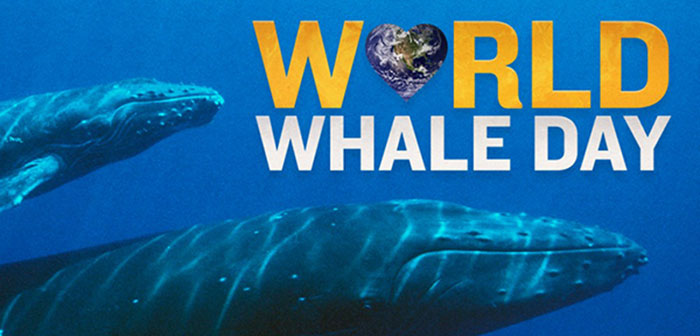
World Whale Day is celebrated annually around the world to raise awareness to protect humpback whales and their ocean habitat.
Various events like World Whale Day and Parade of Whales are conducted in Maui, Hawaii which is organized by the Pacific Whale Foundation, a nonprofit organization whose mission is to save whales from extinction and a pioneer in non-invasive whale research.
To be a part of this Whale Day celebrations let us take part in a fund raising event and support the organization who works for the ocean conservation and to protect whales and other marine life.
Some facts about Humpback Whales:
Today there are at least 80,000 humpback whales world-wide.
An adult humpback whale can grow to an average length of 40-60 ft. long and weigh as much as 44 tons.
Humpback Whale with an open mouth can engulf hundreds or thousands of small fish in a single gulp while using their baleen bristles to separate the water and debris from their prey. After capturing a mouth full of fish the humpback will then push the water out of its mouth using its tongue and swallow the remaining prey.
They migrate to different locations for feeding and mating. During their migration these whales are known to travel as far as 16,000 miles making them one of the furthest migrating species in the world.
Humpback whales communicate with one another using loud low-pitched moans, whines and howls.
During mating periods these sounds may be combined to create melodic tones that are often referred to as whale songs.
The whale song is believed to communicate a desire to mate, to show off health and youthfulness, to show dominance and to challenge other males that are competing for the attention of a female humpback.
A single song may last as long as 20 minutes and male humpback whales may be heard singing for more than 24 hours at a time.
When it comes to giving birth female humpback whales are known to reproduce once every two or three years on average while fertile.
The average gestation period (the period between fertilization and birth) for a humpback whale often lasts between 11 and 12 months.
The calves (baby whales) are typically nursed by their mother for the first year and are fed milk daily through the mother’s nipples.
Calves can drink as much as 600 litres of milk per day.
In terms of lifespan a healthy humpback whale is believed to have a lifespan of up to 50 years.
Source: www.pacificwhale.org / www.whalefacts.org
Image Credit: www.awesomeocean.com
