Planet Mercury
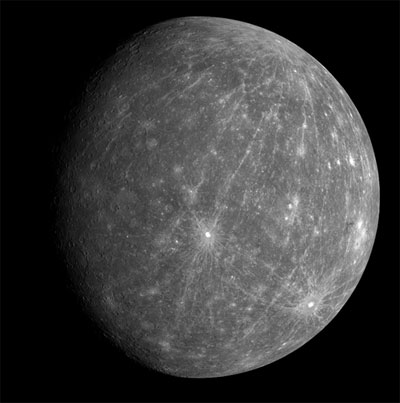
Mercury is the smallest and innermost planet in the Solar System. It is named after the Roman deity Mercury, the messenger to the gods. It moves quickly around the sun and that is how it got its name.
Mercury is a little bigger than Earth’s moon. It is made of heavier materials, like iron. Mercury is heavy, but it is small. Along with Venus, Earth, and Mars, Mercury is one of the rocky planets.
Mercury is covered with holes and these holes are called impact craters. The craters were made by rocks falling from space. The rocks are going very fast when they hit Mercury. A hole is made where the rock hits.
Mercury is also the closest to the sun. It goes around the sun once every 88 Earth days. It takes 59 Earth days to make one full rotation. A day on Mercury lasts a lot longer than a day on Earth. One day on Mercury lasts 59 Earth days. A year on Mercury goes by fast. If you lived on Mercury, you’d have a birthday every three months.
Earth has a blanket of air around it. Mercury does not. The blanket is what helps keep Earth from getting too hot or cold. Because it is so close to the sun, Mercury can be very hot. At night, Mercury gets very cold. We could not live on Mercury.
A day on Mercury is not like a day here on Earth. For us, the sun rises and sets each and every day. Because Mercury has a slow spin and short year, it takes a long time for the sun to rise and set there. Mercury only has one sunrise every 180 Earth days.
Mercury is hard to study because it is so close to the sun. People have never gone to Mercury. Spacecraft without people have gone. Mariner 10 was the first to visit Mercury. It flew by in 1974 and 1975. Not even half of Mercury was seen then. After that, nothing was sent to Mercury for more than 30 years. NASA’s MESSENGER spacecraft flew by Mercury in 2008 and 2009. In March 2011, it began to orbit Mercury. MESSENGER will study parts of Mercury that have not been seen before. It will let scientists learn many new things about the planet.
Source: www.nasa.gov
Image Credit: www.nasa.gov
This picture of Mercury was taken by
NASA’s MESSENGER spacecraft.
