Planet Venus
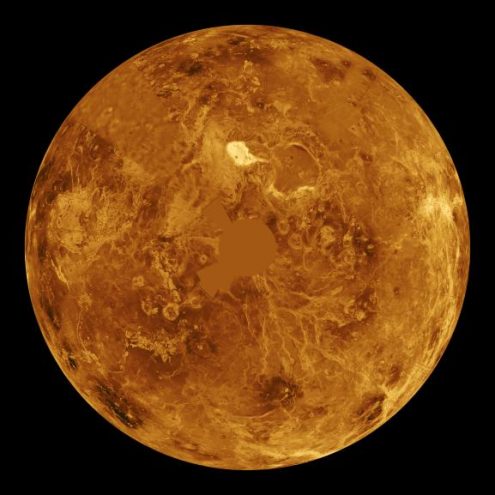
Venus, the second planet from the sun, is named for the Roman goddess of love and beauty.
Venus is roughly the same size as Earth, just slightly smaller.
Venus is one of just two planets that rotate from east to west. Only Venus and Uranus have this “backwards” rotation.
It completes one rotation in 243 Earth days — the longest day of any planet in our solar system, even longer than a whole year on Venus.
Venus is the hottest planet in the solar system with surface temperatures higher than 880 degrees Fahrenheit (470 degrees Celsius) which can melt lead.
It has an iron core that is approximately 2,000 miles (3,200 kilometers) in radius.
Venus has mountains, valleys, and tens of thousands of volcanoes. The highest mountain on Venus, Maxwell Montes, is 20,000 feet high (8.8 kilometers), similar to the highest mountain on Earth, Mount Everest.
A total of 38 spacecraft have at least partially successfully completed a mission at Venus. About a dozen or so more have tried and failed to study this scorching hot world.
No human has visited Venus, but the spacecraft that have been sent to the surface of Venus do not last very long there because of its high surface temperature.
The first successful flyby of Venus was performed by NASA’s Mariner 2 spacecraft on 14 December 1962.
The first successful landing was the Soviet Venera 4 lander, which touched down on the surface on 18 October 1967.
This was followed by a number of other spacecraft in the Soviet Venus exploration programme, culminating in two balloons known as Vega 1 and 2 in June 1985 that flew in the Venusian atmosphere.
Source: www.solarsystem.nasa.gov
Image Credit: www.photojournal.jpl.nasa.gov
