Seven Wonders of the Ancient World – 1
Temple of Artemis at Ephesus
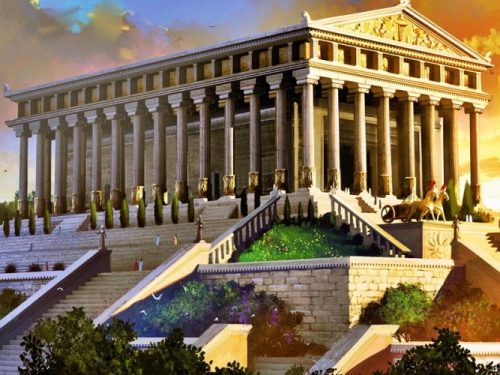
The huge and magnificient Temple of Artemis is one of the Seven wonders of the ancient world.
It was located near the ancient city of Ephesus, about 75 km south from the modern port city of Izmir, in Turkey now called Selcuk.
The temple was designed and built by architect Chersiphron along with his son Metagenes.
It took about 120 years to build it.
The temple was made up of marble with gold and silver decoration and believed to be the first temple or the first building ever built of marble.
The foundation of the temple was built in rectangular size and measured at 150 feet in width and 300 feet in length.
The temple was built with 127 coloumns, each measured 66 feet tall.
The total area of the temple was 125 meters by 60 meters which is equivalent to the size of a soccer ground.
The olympian god Artemis was the daughter of Zeus and Leto and twin sister of Apollo.
The Ephesus goddess Artemis also known as Diana was a goddess of love and fertility. She was also god of hunting, wild animals and the wilderness.
The statue of Artemis was carved of wood with eggs or multiple breasts indicating fetility
The temple of artemis was damaged due to flooding during the 7th century BC. It took 10 years to rebuild it.
The temple was reconstructed by King Croesus of Lydia.
Again the temple was destroyed for the second time by a Greek man named Herostratus who was an arsonist (someone who deliberately setting fire to property). He did this in order to become famous.
The day the temple got destroyed by fire, Alexander the Great was born. Years later, Alexander offered to help rebuild the temple on a condition that his name to be engraved but the people refused to accept his help.
After Alexander the Great died, the temple was finally built for the third time with a measurement of 450 feet long x 225 feet wide, 60 feet high.
The temple stood strong for about 600 years.
The Goths (East Germanic tribe) destroyed the temple again in 268 AD and it was never rebuilt.
Archeologists, researchers started their excavations and found several artifacts which are exhibited at the British Museum in London.
Today, only a single column and a few sculptural fragments stands as a reminder of this magnificent temple.
Antipater of Sidon, who compiled the list of the Seven Wonders, describes the finished temple:
I have set eyes on the wall of lofty Babylon on which is a road for chariots, and the statue of Zeus by the Alpheus, and the hanging gardens, and the colossus of the Sun, and the huge labour of the high pyramids, and the vast tomb of Mausolus; but when I saw the house of Artemis that mounted to the clouds, those other marvels lost their brilliancy, and I said, “Lo, apart from Olympus, the Sun never looked on aught so grand”.
Image Credit: www.penapensante.com.br
